


Shade grants are grant or public-funding programs that can help schools, parks, churches, child care providers, and nonprofit recreation sites pay for permanent shade structures, playground improvements, or outdoor play-space upgrades.
For most buyers, choose the funding lane before choosing the final shade layout. A school applying for the AAD Shade Structure Grant Program has a different file to assemble than a city applying through LWCF State and Local Assistance or an urban park pursuing ORLP.
If you are still choosing the equipment package, start with the commercial shade structures collection, then use this guide to match the project to a realistic funding path.
Which shade grant should a school, park, or church check first?
A school or nonprofit serving children should usually check the AAD Shade Structure Grant Program first, while a city or county park should usually check LWCF, ORLP, CDBG, and its state park-grant channel before smaller private programs.
| Funding lane | Best fit | What to verify before quoting | Source |
|---|---|---|---|
| AAD Shade Structure Grant Program | Public schools and nonprofit organizations serving children and teenagers | Permanent shade structure, sun-safety program, dermatologist recommendation, and current application window | AAD application page |
| Community Development Block Grant (CDBG) | Local governments funding public facilities or improvements tied to an eligible national objective | Whether the project is part of an eligible public-facility improvement and meets the local CDBG plan | HUD CDBG eligible activities |
| LWCF State & Local Assistance | Public outdoor recreation projects sponsored through the state program | State application process, public outdoor recreation purpose, and matching-fund requirement | NPS LWCF Manual v2026 |
| Outdoor Recreation Legacy Partnership (ORLP) | Urban communities creating or improving public parks and outdoor recreation spaces | Population eligibility, project location, sponsor route, and current Grants.gov notice | NPS ORLP page |
| USDA Community Facilities Direct Loan & Grant | Rural public bodies, nonprofit corporations, and federally recognized Tribes | Rural eligibility, essential-community-facility fit, and grant-share tier | USDA Rural Development |
| CCDF/CCDBG state quality funds | Child care and early learning providers working through state, territory, or Tribal lead agencies | Whether the state or Tribal plan allows provider grants, equipment, outdoor play-space work, or facility improvements | ACF Office of Child Care fact sheet |
How does the AAD Shade Structure Grant Program work?
The AAD Shade Structure Grant Program is a specific shade-funding program for public schools and qualifying nonprofit organizations that serve children and teenagers. AAD says the program awards up to $8,000 for permanent shade structures, and the 2026 application page says the 2026 window is closed and applicants should check back in the fall for 2027.
AAD says the structure must be permanent, the applicant needs a sun-safety program, and the application needs a recommendation from an AAD member dermatologist. AAD also says winners must submit a W9 and vendor invoice within 45 days of award notification, and shade installations must be completed by November 30.
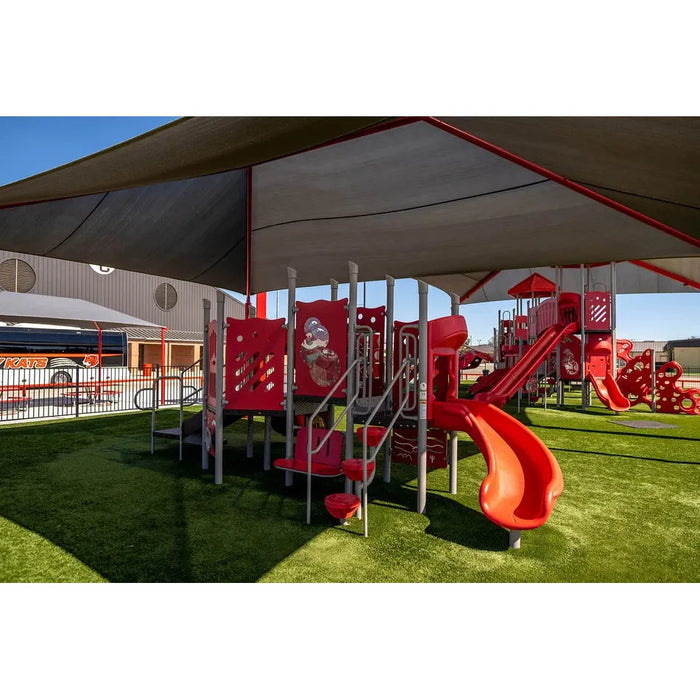
Can CDBG funds pay for shade or playground improvements?
CDBG can be relevant when the shade or playground work is part of an eligible public facility or public improvement. HUD lists construction of public facilities and improvements among eligible CDBG activities, and each activity must meet a national objective such as benefit to low- and moderate-income people, slum or blight prevention, or urgent community need.
When is LWCF a better match than a private shade grant?
LWCF is a better match when the buyer is improving public outdoor recreation space and can work through the state program. NPS says LWCF State and Local Assistance supports locally led outdoor recreation projects through matching grants to state and local governments, and the 2026 LWCF Manual lists playgrounds and tot lots as eligible development examples.
What is ORLP, and who should look at it?
ORLP is the urban-park branch of the LWCF family, aimed at creating or reinvigorating public parks and outdoor recreation spaces in eligible communities. NPS describes basic ORLP population eligibility as communities of 25,000 or more, while federally recognized Tribes, Alaska Native organizations, and Native Hawaiian community organizations are eligible regardless of population.
Can USDA Community Facilities funding support playground or shade work?
USDA Community Facilities funding can support essential community facilities in rural areas, but the project has to fit the program rather than merely be outdoors. USDA says eligible borrowers include public bodies, community-based nonprofit corporations, and federally recognized Tribes, and eligible rural areas generally have no more than 20,000 residents.
USDA also says funds may be used to purchase, construct, improve, and equip essential community facilities. USDA says grant assistance is limited by a graduated scale, with maximum grant shares from 15 percent to 75 percent depending on population and median-household-income criteria.
Do child care programs have separate funding options?
Child care programs should check CCDF/CCDBG channels through their state, territory, or Tribal lead agency because CCDF is administered through those agencies, not as one national application for every provider. ACF describes CCDF as the primary federal funding source for child care subsidies and quality improvement, and ACF says a portion of CCDF funds must be used for quality activities.
Are KABOOM!, AHA/NFL PLAY 60, and Lowe's Hometowns worth checking?
They are worth checking, but each is narrower than a broad capital-project grant. KABOOM! maintains an active apply-for-a-grant page for play-space opportunities. The American Heart Association describes NFL PLAY 60 school grants as supporting physical-activity initiatives including equipment, outdoor play spaces, and wellness programs. Lowe's Community Impact Grants under Lowe's Hometowns are active as a program, but the current grant window must be checked before presenting it as available now.
What should the quote package include before a grant application?
A grant-ready quote package should make the funder's review easier: product family, intended use, site owner, installation location, estimated dimensions, mounting type, surface assumptions, lead-time assumptions, and whether the project includes playground equipment, shade, surfacing, or multiple scopes.
| Project detail | Why funders ask for it | Where it shows up |
|---|---|---|
| Permanent structure type | AAD requires a permanent qualifying shade structure and excludes some structure types | AAD FAQ |
| Outdoor recreation use | LWCF development eligibility centers on public outdoor recreation areas and facilities | LWCF Manual v2026 |
| Community-benefit narrative | CDBG projects must meet a national objective, not just a purchasing need | HUD CDBG page |
| Rural eligibility and facility purpose | USDA Community Facilities uses rural eligibility and essential-facility criteria | USDA Community Facilities |
For shade projects, the Rectangle Hip Shade is a practical quoting reference because it is used for schools, parks, churches, playgrounds, seating, and pool areas. The product page lists standard entry heights of 8 ft., 10 ft., and 12 ft.; in-ground or surface mounting; size options from 10 ft. to 60 ft.; and framework and fabric warranty terms.
For sites where columns are the main constraint, the Single Post Pyramid Shade Structure can be easier to discuss early because the product page says it can provide almost 400 square feet of shade from one column.
How should buyers avoid wasting time on the wrong funding path?
Buyers should screen the applicant first, the project purpose second, and the application timing third. If the applicant is not eligible, the best quote in the world will not rescue the application.
- Schools and youth-serving nonprofits should start with AAD and school-wellness programs.
- Municipal parks should check state LWCF channels, ORLP eligibility, CDBG planning staff, and state park grants.
- Rural public bodies, nonprofit corporations, and federally recognized Tribes should ask USDA Rural Development whether the project fits an essential community facility.
- Child care providers should ask their state, territory, or Tribal lead agency about CCDF/CCDBG quality or facility-improvement options.
- Churches should separate worship-facility funding from community-serving recreation, school, or nonprofit programming.
Outdoor Workout Supply can help assemble a quote for commercial shade structures, playground equipment, surfacing, outdoor fitness, and related site amenities. For broader planning, compare this guide with our playground funding guide, school playground funding guide, and outdoor fitness funding guide.
Parts of this article were drafted with AI assistance; every factual claim was sourced, checked, and edited by our team before publication.
FAQ
Are shade grants only for schools?
No; this AAD program names public schools and qualifying nonprofit organizations, while other funding lanes such as CDBG, LWCF, ORLP, USDA Community Facilities, and CCDF/CCDBG depend on the applicant type and project purpose.
Can a grant pay for a shade structure that is already installed?
For the AAD Shade Structure Grant Program, no. AAD says applications for retroactive funds for an already installed shade structure are not accepted.
Should we get a quote before applying?
Yes. AAD winners must submit a vendor invoice within 45 days of award notification, and other public-funding applications commonly need enough project detail to evaluate eligibility, budget, and schedule.
Can one grant cover shade, playground equipment, and surfacing together?
Sometimes, but the answer depends on the program. Public recreation and community-facility funding may allow broader site improvements, while shade-specific programs may focus on the permanent shade structure itself.
